Teaching & Learning (T&L)
Preparing Transformative Educators
- Elementary and secondary teacher preparation
- Mathematics, science, literacy, and STEM education
- Instructional design and educational technology
- Innovative teaching and learning research
Our expertise range from Elementary Education, Secondary Education, Physical Education, ESOL/World Languages Education, Early Childhood Education, Advanced Studies in Teaching & Learning, Mathematics Specialist Leadership, Literacy
Building AI-Ready Educators
School leaders across Northern Virginia have identified an urgent need for educators who understand both the opportunities and challenges presented by artificial intelligence. Teacher preparation programs must move beyond simply using AI tools to helping educators understand how AI works, evaluate AI outputs critically, analyze ethical implications, and apply AI responsibly within their disciplines.
Teaching IDE-AI addresses this need by focusing on five priorities:
- Building AI literacy among teacher educators
- Integrating AI into teacher education pedagogy
- Preparing k-12 educators for an AI-driven society
- Providing sustained professional development and resources
- Ensuring ethical, equitable, and policy-aligned implementation of AI in education
Showcasing Disciplinary AI in Teaching, Research & Outreach
Spotlight: Preparing Students for an AI-Enabled Future
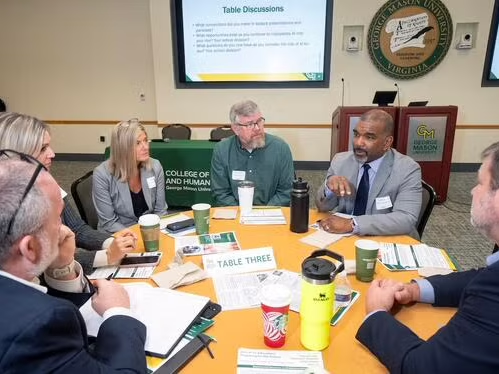
At the recent Educational Research Alliance of Northern Virginia (ERA-NOVA) convening hosted by George Mason University’s College of Education and Human Development, educational leaders, faculty, and community partners explored how schools can prepare students for a world increasingly shaped by artificial intelligence. The conversation emphasized that the goal is not simply to teach students how to use AI, but to develop the critical thinking, creativity, problem-solving, ethical reasoning, and sound judgment needed to thrive alongside it.
One of ERA.NOVA’s greatest strengths is creating space for school divisions and university partners to wrestle with these questions together,” said Audra Parker, Director of the Office for Teacher Preparation at George Mason’s CEHD. AI is evolving rapidly, and no one organization has all the answers. By learning from one another and grounding our work in both research and practice, we can better prepare educators and students for what’s ahead.”
Discussions focused on building educator capacity through AI literacy, professional learning, and responsible classroom integration. A shared message emerged: AI should augment, not replace, human expertise, while meaningful learning continues to depend on strong relationships and thoughtful instruction.
Aligned with CEHD’s mission of innovation and societal impact, the college is advancing research and partnerships that ensure AI in education remains grounded in human potential and purpose.
Read More…
https://www.gmu.edu/news/2026-08/preparing-students-ai-enabled-future-era-nova
Spotlight: AI + Mathematical Modeling = A New Tool for Teaching
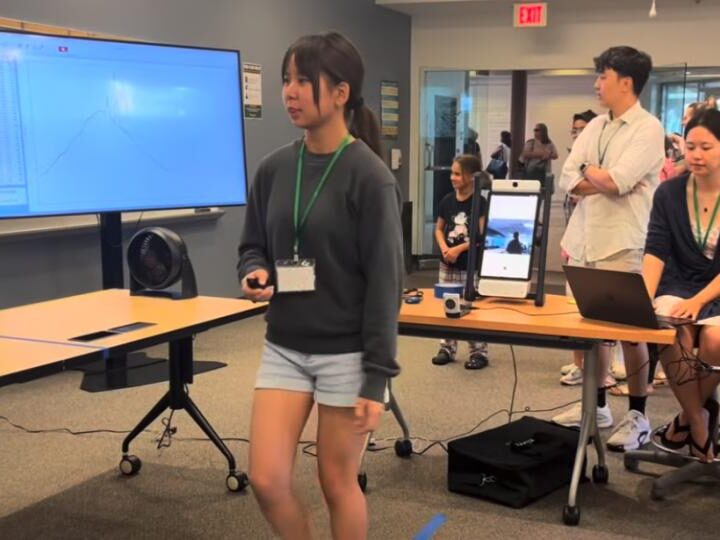
Professor Jennifer Suh, Assistant Professor Ziyu Yao, and collaborator Janice Zhang are leading an innovative National Science Foundation-funded project called MathVC, a virtual classroom that combines artificial intelligence and mathematical modeling to help middle school students solve authentic, real-world problems. Building on earlier support from Microsoft’s Accelerating Foundation Models initiative, MathVC allows students to collaborate with AI-powered chatbot peers as they work through complex modeling challenges that connect mathematics to issues ranging from everyday decision-making to global problems.
The project is designed to strengthen both mathematical reasoning and essential 21st-century skills, including communication, collaboration, critical thinking, and problem-solving. By simulating peer interactions, MathVC creates new opportunities for multilingual learners, students who need support in mathematical discourse, and teachers managing large classrooms. The team is also studying how students communicate, reason, and learn within AI-supported environments through Math EdVentures Camp, generating valuable insights into human-AI collaboration. This work exemplifies how AI can expand access to high-quality learning experiences while enhancing, rather than replacing, the human interactions that are central to effective mathematics education.
Read More…
https://www.gmu.edu/news/2025-09/ai-plus-mathematical-modeling-equals-new-tool-teaching
AI Resources in Teaching and Learning
- For a teacher educator, researcher, or instructional designer
1. Read, Research & Synthesize
NotebookLM
Convert articles, reports, PDFs, and books into study guides, FAQs, podcasts, and summaries.
🔗 https://notebooklm.google.com
Elicit
AI-powered literature review and evidence synthesis tool.
🔗 Elicit
Consensus
Search research literature using natural language questions.
🔗 Consensus
ResearchRabbit
Visualize research networks, citations, and related authors.
🔗 ResearchRabbit
Connected Papers
Explore connections among research articles.
🔗 Connected Papers
2. Visualize Ideas & Create Conceptual Frameworks
Napkin AI
Transforms notes and text into professional diagrams and visual frameworks.
🔗 Napkin AI
Whimsical
Create concept maps, curriculum maps, flowcharts, and learning progressions.
🔗 Whimsical
Miro AI
Collaborative whiteboarding and design thinking.
🔗 Miro
FigJam AI
Interactive collaborative brainstorming and workshop planning.
🔗 https://www.figma.com/figjam
Lucidchart AI
Generate diagrams, systems models, and process maps.
🔗 Lucidchart
3. Design Courses, Lessons & Learning Experiences
ChatGPT
Excellent for lesson design, rubrics, differentiation, and discussion prompts.
🔗 ChatGPT
Microsoft Copilot
Integrated productivity tool for lesson planning, assessment design, and document creation.
🔗 Microsoft Copilot
Claude
Particularly strong for long documents, curriculum design, and literature synthesis.
🔗 Claude
MagicSchool AI
Comprehensive suite of educator-focused tools.
🔗 MagicSchool
Eduaide.ai
Lesson planning, assessment development, differentiation, and feedback.
🔗 Eduaide
Brisk Teaching
AI directly embedded in Google Docs, Slides, and websites.
🔗 Brisk Teaching
Diffit
Adapt readings for multiple grade levels and learner needs.
🔗 Diffit
4. Create Presentations & Learning Materials
Gamma
Turn outlines and prompts into presentations, reports, and websites.
🔗 Gamma
Canva Magic Studio
Create slides, infographics, videos, and visual learning resources.
🔗 Canva AI
Beautiful.ai
Automated slide design and visual presentation development.
🔗 Beautiful.ai
Tome
AI-powered storytelling and presentation creation.
🔗 Tome
Prezi AI
Dynamic presentation and visual storytelling platform.
🔗 Prezi
5. Design Assessments & Feedback
Khanmigo
Socratic questioning and tutoring support.
🔗 https://www.khanacademy.org/khan-labs
QuestionWell
Generate quizzes and discussion questions.
🔗 QuestionWell
Formative AI
Create assessments and provide formative feedback.
🔗 https://goformative.com
Class Companion
AI-supported student feedback and writing review.
🔗 Class Companion
6. Create Multimedia & Learning Objects
Synthesia
Generate instructional videos with AI avatars.
🔗 Synthesia
Pika
Create short educational videos from prompts.
🔗 Pika
Adobe Express AI
Create graphics, videos, animations, and classroom materials.
🔗 Adobe Express
Descript
Video editing, podcasting, transcription, and captioning.
Research → Synthesize → Visualize → Design → Create → Assess → Reflect
Critical Equity AI site by Melissa Warr
https://equityinai.net/