Teaching Initiative for Digital Education through AI
Human-Centered AI Literacy for Every Discipline
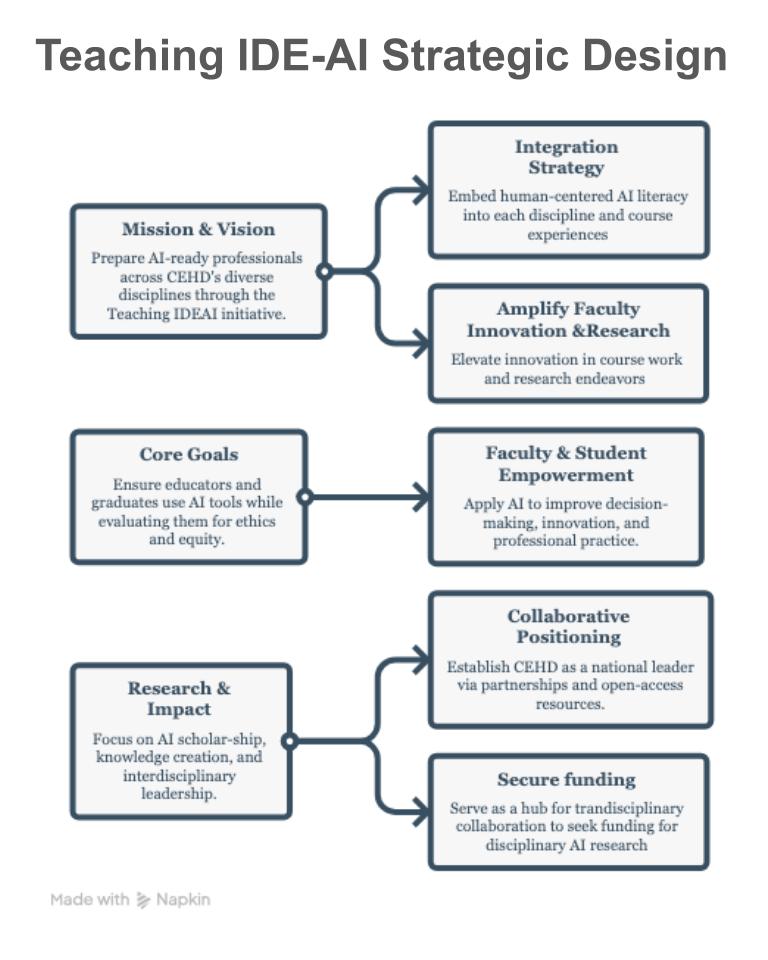
Teaching IDEAI positions the College of Education and Human Development (CEHD) as a national leader in preparing professionals for an AI-enabled future by integrating human-centered AI literacy with the disciplinary expertise of the diverse program area.
This signature initiative prepares AI-ready professionals across CEHD by embedding human-centered AI literacy into disciplinary coursework, professional practice, and research. The initiative empowers faculty and students to use AI ethically and effectively to enhance decision-making, innovation, teaching, leadership, wellness, and community impact.
Through faculty innovation, interdisciplinary collaboration, open-access resources, and research-practice partnerships, Teaching IDE-AI advances both professional learning and knowledge creation.
By positioning CEHD as a leader in AI scholarship and responsible innovation, the initiative generates new evidence, secures strategic collaborations and funding, and shapes the future of education and human development.
This initiative is timely and critical in light of the challenges faced in our society where AI capabilities is advancing faster than our ability to understand its effect on learning and AI adoption outpaces research on the impact on human agency and disciplinary reasoning.
Teaching IDEAI offers a solution by advancing AI research, innovation, and evidence-based practice by fostering interdisciplinary inquiry, research-practice partnerships, and the creation of new knowledge about AI’s role in learning, development, health, and human well-being.
The initiative advances CEHD’s mission as an inclusive community of scholars, educators, and practitioners dedicated to lifelong learning, well-being, and transdisciplinary innovation that positively impacts local and global communities. Teaching IDEAI strengthens professional preparation and leadership while advancing George Mason University’s commitment to responsible digital innovation and 21st-century education research through transdisciplinary collaboration.
Our Vision and Framework
Teaching IDE-AI (Institute for Digital Education through AI) initiative is designed to prepare AI-ready educators across every program and discipline in the College of Education and Human Development (CEHD) by providing faculty, teacher candidates, graduate students, and practitioners with the knowledge, skills, and ethical frameworks needed to integrate artificial intelligence responsibly, equitably, and effectively into their professional contexts. The initiative emphasizes AI literacy, data ethics, critical thinking, human-centered design, and discipline-specific applications of AI, ensuring that graduates are prepared to lead, teach, serve, and innovate in an AI-driven world.
Through interdisciplinary collaboration across the College of Education and Human Development, the College of Engineering and Computing, the Schar School of Policy and Government, university centers, school divisions, and industry partners, Teaching IDE-AI is creating a sustainable ecosystem for innovation, research, and professional learning.
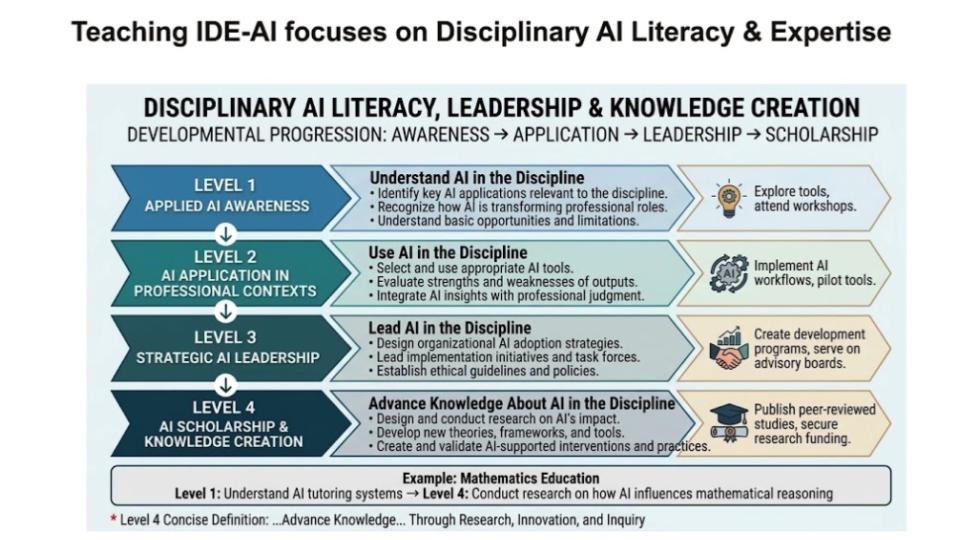
CEHD’s Disciplinary AI Literacy, Leadership, and Knowledge Creation Framework is our signature priority.
Applied AI Awareness: Understanding how AI is used within a profession.
AI Application in Professional Contexts: Using AI to improve practice, learning, and decision-making.
Strategic AI Leadership: Evaluating, refining, and leading responsible AI adoption within a profession.
AI Scholarship & Knowledge Creation: Advancing knowledge through research, innovation, evaluation, and dissemination.
Through Levels 1-3, we focus on understanding, applying, and leading AI within a discipline, Level 4 emphasizes conducting research that generates new knowledge about how AI transforms learning, development, leadership, equity, accessibility, well-being, and professional practice across fields. We position AI Scholarship & Knowledge Creation (Level 4) as CEHD’s signature priority as it is grounded in CEHD’s strengths in innovation, research, and societal impact. This level positions the college not only as a consumer of AI tools but as a producer of evidence, frameworks, and discoveries that shape the future of AI in education and human development.
Based on this interdisciplinary professional learning, open-access AI literacy modules, faculty learning communities, AI-enhanced practice environments, and research-to-practice collaborations, Teaching IDE-AI supports all CEHD programs, including teacher preparation, counseling, special education, educational leadership, educational psychology, learning technologies, kinesiology, sport management, recreation and tourism studies, school psychology, literacy, ESOL, mathematics specialist leadership, and doctoral programs. The initiative recognizes that AI impacts every profession represented within CEHD and therefore prepares educators and professionals to critically evaluate AI tools, address issues of equity and bias, leverage data-informed decision-making, and use emerging technologies to improve learning, assessment, communication, accessibility, wellness, leadership, and community engagement.
By embedding AI literacy across undergraduate, master’s, certificate, and doctoral programs, Teaching IDE-AI creates a multiplier effect: faculty become AI-capable instructors, graduates become AI-ready professionals, and the individuals they serve become better equipped to thrive in a rapidly changing digital society. In this way, Teaching IDE-AI advances CEHD’s mission of preparing ethical, innovative, and future-focused leaders across education, health, human services, and community-based professions.
Examples Across CEHD Programs
- Teacher Education (Elementary, Secondary, ESOL, Foreign Language, Special Education, Literacy): AI-supported instructional design, assessment, multilingual learning, accessibility, and differentiated instruction.
- Educational Leadership and Policy: AI-informed decision-making, data analytics, organizational leadership, and policy development.
- Counseling, School Psychology, and Educational Psychology: Ethical AI use in assessment, mental health supports, student services, and research.
- Autism Spectrum Disorders and Assistive Technology: AI-powered accessibility tools, communication supports, and personalized interventions.
- Learning Design and Technology: Design, evaluation, and implementation of AI-enhanced learning systems.
- Kinesiology, Athletic Training, Health and Physical Education: AI applications in performance analysis, wellness monitoring, and coaching.
- Sport Management, Recreation Management, Tourism and Events Management: Data-driven planning, customer engagement, forecasting, and organizational innovation.
- Research Methodology and PhD Programs: Responsible AI research methods, analytics, ethics, and interdisciplinary scholarship.
- Mason LIFE: Accessible and inclusive AI tools that promote independence, communication, and participation.
Through these applications, Teaching IDE-AI positions CEHD as a leader in developing professionals who can harness AI responsibly while maintaining a strong commitment to human-centered, ethical, and equitable practice.