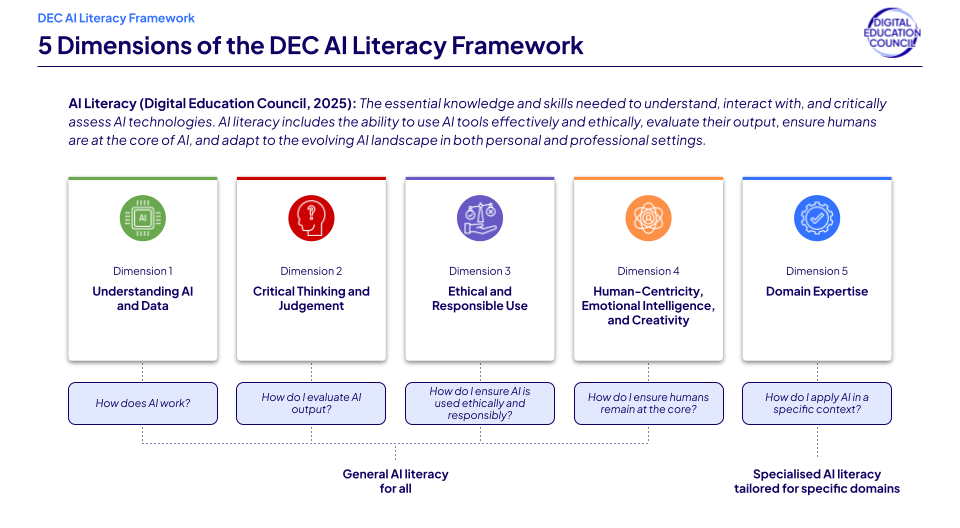
Using the five dimensions of the DEC AI Literacy Framework form the Digital Education Council, we will provide a learning opportunity for teacher educators (https://www.digitaleducationcouncil.com/post/digital-education-council-ai-literacy-framework)
For a Teaching IDEAI professional learning sequence, each module will intentionally weave the five dimensions of the DEC AI Literacy Framework so that teacher educators develop not only technical AI skills, but also the judgment and pedagogical expertise needed to use AI responsibly in teacher preparation.
Dimension 1: Understanding AI and Data
Focus: How AI works, where AI gets its information, and how data influences outputs.
Across the modules, participants explore foundational AI concepts such as machine learning, large language models, prompting, training data, bias in datasets, and the strengths and limitations of AI-generated content. Teacher educators learn to distinguish between generative AI, predictive AI, and adaptive learning systems while examining how AI tools used in education are developed and trained.
Dimension 2: Critical Thinking and Judgment
Focus: Evaluating AI-generated outputs and making informed decisions.
Modules emphasize analyzing and critiquing AI responses, lesson plans, assessments, feedback, and recommendations. Participants learn strategies for verifying accuracy, identifying hallucinations, recognizing bias, comparing human and AI-generated content, and determining when professional judgment should override AI suggestions. Teacher educators practice using AI as a thought partner rather than an unquestioned authority.
Dimension 3: Ethical and Responsible Use
Focus: Using AI safely, legally, and ethically.
Throughout the modules, participants examine issues related to privacy, intellectual property, transparency, accessibility, academic integrity, bias, and equity. Teacher educators engage in case studies involving classroom scenarios and develop guidelines for responsible AI adoption in teacher preparation programs. Special attention is given to protecting student data and promoting equitable access to AI-supported learning opportunities.
Dimension 4: Human-Centricity, Emotional Intelligence, and Creativity
Focus: Ensuring humans remain at the center of teaching and learning.
Modules emphasize that effective teaching requires empathy, relationship-building, cultural responsiveness, and professional judgment that AI cannot replace. Participants learn how AI can enhance creativity, facilitate brainstorming, support differentiated instruction, and reduce administrative burdens while preserving the human dimensions of mentoring, coaching, and teacher learning. Activities encourage educators to critically examine when human interaction is essential and when AI can provide productive support.
Dimension 5: Domain Expertise
Focus: Applying AI within teacher education and mathematics education contexts.
Teacher educators learn to apply AI specifically to lesson planning, instructional design, formative assessment, mathematical discourse, curriculum analysis, coaching conversations, and teacher professional learning. Participants examine discipline-specific examples and use AI to support high-leverage teaching practices, learning trajectories, culturally responsive mathematics instruction, and evidence-based pedagogical decision-making. This dimension ensures that AI literacy is connected directly to the realities of teacher preparation and classroom practice rather than remaining a general technology skill.
Integrated Across All Modules
The Teaching IDEAI curriculum positions the five dimensions as a progression:
Understand AI → Evaluate AI → Use AI Responsibly → Keep Humans at the Center → Apply AI Expertly in Teacher Education
This progression helps teacher educators move from basic AI literacy toward becoming thoughtful leaders who can model effective, ethical, and pedagogically sound AI practices for the next generation of teachers
AI Ready Educator- Microcredential

Issued by George Mason University
Recipients of the Teaching IDEAI Badge demonstrate the ability to critically, ethically, and effectively integrate AI into education. They can evaluate AI-generated content, apply human-centered and equitable decision-making, safeguard privacy and academic integrity, and use AI to enhance instruction, assessment, coaching, and professional learning while maintaining sound pedagogical judgment and domain expertise.Recipients of the Teaching IDEAI Badge demonstrate the ability to critically, ethically, and effectively integrate AI into education. They can evaluate AI-generated content, apply human-centered and equitable decision-making, safeguard privacy and academic integrity, and use AI to enhance instruction, assessment, coaching, and professional learning while maintaining sound pedagogical judgment and domain expertise.
I
Timeline
Summer 2026
- Planning and design of Teaching IDEAI
- Develop AI Ready Educator microcredential
- Recruit faculty cohort
- IRB approval and research design
Fall 2026
- Launch AI Ready Educator Microcredential
- Five AI literacy webinars
- Faculty Learning Community
- Digital badge completion and innovation planning
Winter 2026-2027
- Faculty innovation project development
- Collaborative grant proposal writing
- Submission of external funding proposals
Spring 2027
- AI-Enhanced Lesson Study Cycles
- Faculty Learning & Research Community
- Research data collection and reflection
- GMU Teaching IDE-AI Research Symposium
Summer 2027
- Dissemination at professional organizations
- Conference presentations and publications
- Grant Writing Boot Camp
- Expansion of faculty partnerships
Beyond 2027
- Sustainable AI educator network
- Multi-institution research collaborations
- National grant-funded initiatives
- Open-access AI literacy resources and professional learning ecosystem